Billing FAQs
Your billing questions
Have a look through our frequently asked questions to see if we can answer your question.
The average bill will go up by 6% a year for water and wastewater services.
Our bills will remain among the lowest in the country for water and wastewater services. For a detailed breakdown of our charges, go to our charges 2026/27.
Over the next five years, we’re investing £2.6 billion in the region to improve the local water and sewer network.
To support this investment, bills will go up alongside increased investment from shareholders.
This major investment will upgrade key infrastructure, including pipelines, treatment works and pumping stations, meaning cleaner rivers, fewer flooding incidents and a reliable and resilient water supply now and for generations to come.
Every penny of this increase is going directly into improving our region. We’re also committed to spending 60p of every pound with local suppliers to make sure this investment stays in our region to support jobs and our local economy.
Work is already underway, with a number of projects in progress across the region, tackling everything from replacing aging water mains and upgrading sewer networks to improving treatment works.
These improvements are already reducing storm overflow spills, protecting rivers, and strengthening resilience for homes and businesses.
Some of these projects include:
- Middlesbrough - 23km of water mains are being replaced as part of a £5m investment in water quality and to protect supplies for 2,600 homes and businesses in the area.
- Belsay, Northumberland – a £1.7m project to upgrade 15km of water mains between Quarry Close Point and Boghall Junction began in November 2025. The work will improve water quality and reliability for customers.
- Browney, County Durham – a £10m scheme upgrading Browney Sewage Treatment Works to increase capacity, improve treatment processes and protect the River Browney. Work will complete in winter 2027.
Nearly 800 projects are planned across the region over the next four years and include:
- Chester le Street, County Durham - A £52m investment to protect the environment is expected to begin in 2027. This will involve work to reduce the frequency of spills from 12 storm overflows in the area.
- Ouseburn, Newcastle – a £6m investment will start towards the end of 2026 and will focus on reducing storm overflow discharges and upgrading local sewer infrastructure. These improvements will help protect water quality in the Ouseburn and surrounding communities.
- Berwick-upon-Tweed - A £175m project to replace outdated storm tanks, install innovative smart monitoring, and strengthen the sewer network, reducing storm overflow incidents and improving water quality. Work begins in Spring 2027.
- Darlington – planning is underway for £25.6m worth of upgrades at Stressholme Sewage Treatment Works, alongside a £13.5m package of measures to reduce spills from storm overflows, which will protect the River Tees.
For more information about investments in your area, go to our investment plan page.
These will also create 3,000 jobs per year across Northumbrian Water Group and contribute £5.7bn to the North East economy through employment and the use of local suppliers.
We understand that a bill increase will be concerning.
Last year we helped over 100,000 customers with financial support, and we want to continue to help those who need it. That's why we have offer a range of financial support options.
We provide flexible payment plans to spread the cost of your bill, along with financial support schemes such as low income discounts, bill caps, and the option to pay your bill using benefits.
Use our eligibility checker to find out which financial support schemes you can apply for.
Small changes in how you use water can add up to big savings on your bills.
- Use our water and energy calculator to see how much you're using and learn how you can save. You can also order free water saving devices to help reduce your usage.
- Check out our water saving tips for the home and garden to help you save both water and energy.
- Log in to your online account, to track your usage and see how it compare it to similar homes.
- If your bill is higher than normal, check out our high bill advice. It could be something simple as a leaking tap or toilet.
You can choose to spread the cost by paying monthly. If you pay in full, we'll refund you any amount owed to you when you move.
When you move home, it's easy to let us know your moving home online.
There are a few reasons this might happen.
Your neighbour could have a water meter, or if you both don't have a meter, the properties may have different rateable values for billing.
We're unable to speculate the reason why it’s different or share information about someone else’s account.
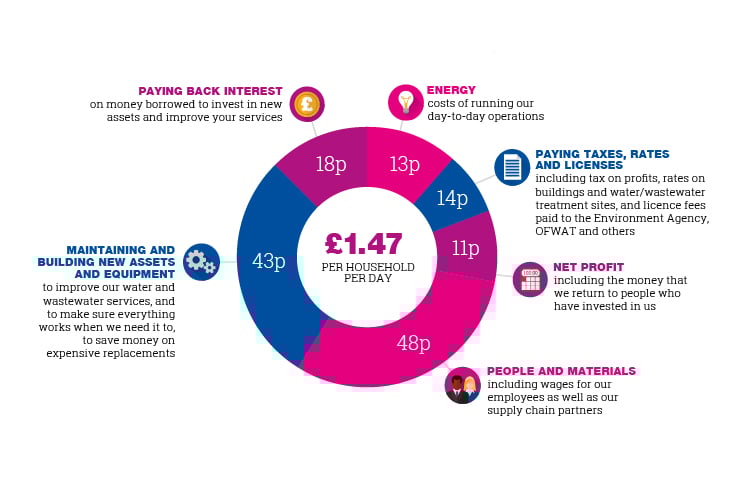
Based on the average household bill in 2026/27, water and sewerage charges will cost £1.47 per day.
If you own an empty property, you might ask yourself, do I still pay the water charges?
You'll still need to pay water and sewerage charges for the empty property if:
- your property is furnished, and
- the water is connected, and used for any purpose, like renovation.
But, if you agree that we can turn your water supply off, we won't charge you.
If you'd like to turn the water supply off, just contact us.
Rateable values are used to work out how much to charge properties that do not have water meters.
They were decided by the valuation office and can be different for every home. Rateable values were frozen in 1990, when council tax was introduced, and they have stayed the same since.
How do we use rateable value to bill our customers?
We bill customers who don’t have a water meter by multiplying the rateable value by the charges for the water and sewerage services we provide to your home.
Thinking about getting a water meter?
Rateable values are not set to the actual amount of water you use. That’s why a lot of our customers save money by having a water meter fitted.
Try our water usage calculator to see if you can save money on a meter. You can also apply online for a water meter.
If we cannot fit a water meter at your home, we would look to apply an assessed measured charge (AMC).
The assessed charges are a fixed annual charge, based on assumed volumes of water usage.
There are two assessed charges available:
1. Single occupier.
2. Standard.
If you're closing your account, and you're due a refund, we'll get it sent out as soon as possible.
If you paid your bills by Direct Debit and haven't cancelled it yet, we can refund you directly to your bank account.
If that isn't an option, we'll pop a cheque in the post.
We do advise that current customers keep credit on their account, to cover any costs throughout the year.
Are you sure?
Changes are waiting to be saved